
2026 Monthly Report (April 01 - April 30)
On this page
- Introduction
- Contributor Statistics
- Feature Highlights
- 1. Support AWS Bedrock in ai-proxy Plugin
- 2. Add Per-Protocol request_body Override and Rename max_tokens Mapping to llm_options
- 3. Add Provider-Aware max_tokens Override with Priority Control
- 4. Abort Upstream Read on Client Disconnect During Streaming
- 5. Add max_stream_duration_ms and max_response_bytes Safeguards
- 6. Add core.response.get_response_source() API for Response Origin Classification
- 7. Make /configs/validate Available in All Modes
- 8. Upgrade lua-resty-limit-traffic to v1.2.0 in limit-count
- 9. Add Expression-Based Limit Strategy in ai-rate-limiting
- 10. Add OpenAI Responses API (/v1/responses) Support
- 11. Enhance encrypt_fields to Support Nested Structures
- 12. Add rate-limiting-info Variable
- 13. Add Native Anthropic Messages API Protocol Support
- 14. Add UUID v7 Generation Support in request-id
- 15. Support Batch TCP/UDP Port Ranges in stream_proxy Config
- Conclusion

Recently, we’ve introduced and updated some new features, including AWS Bedrock support in
ai-proxy, native Anthropic Messages API protocol support, OpenAI Responses API support, expression-based rate limiting inai-rate-limiting, UUID v7 generation inrequest-id, and more. For more details, please read this month’s newsletter.
Introduction
From its inception, the Apache APISIX project has embraced the ethos of open-source community collaboration, propelling it into the ranks of the most active global open-source API gateway projects. The proverbial wisdom of ‘teamwork makes the dream work’ rings true in our way and is made possible by the collective effort of our community.
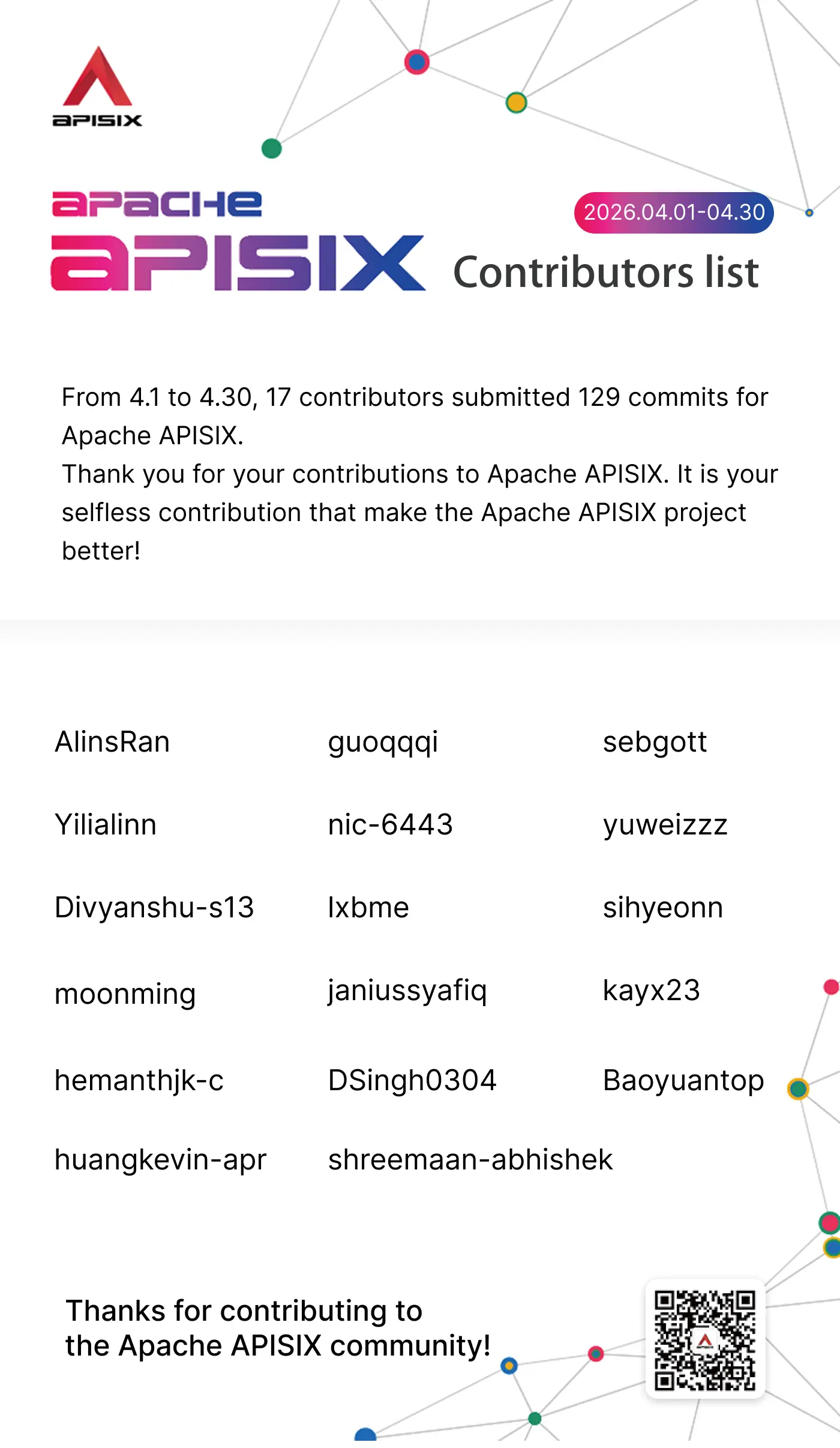
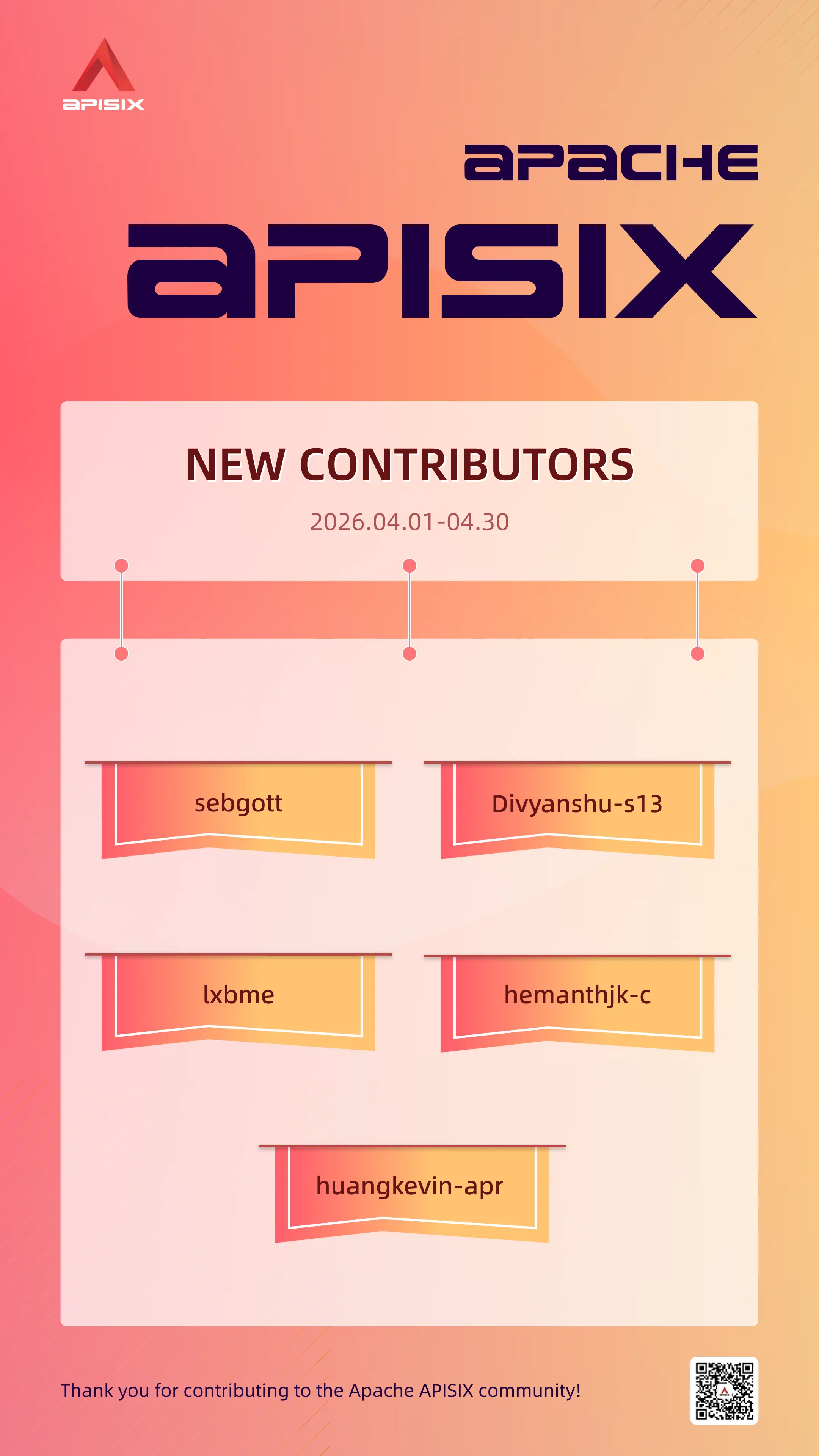
From April 1st to April 30th, 17 contributors made 129 commits to Apache APISIX. We sincerely appreciate your contributions to Apache APISIX.
Contributor Statistics
Feature Highlights
1. Support AWS Bedrock in ai-proxy Plugin
PR: https://github.com/apache/apisix/pull/13249
Contributor: shreemaan-abhishek
This PR adds AWS Bedrock as a supported provider in the ai-proxy plugin. Users can now route AI requests to models hosted on AWS Bedrock using the same unified interface, expanding the range of supported AI platforms alongside existing providers like OpenAI and Anthropic.
2. Add Per-Protocol request_body Override and Rename max_tokens Mapping to llm_options
PR: https://github.com/apache/apisix/pull/13269
Contributor: nic-6443
This PR allows users to override the request body on a per-protocol basis in the ai-proxy plugin, providing finer-grained control over how requests are sent to different AI providers. It also renames the max_tokens mapping field to llm_options for improved clarity and extensibility.
3. Add Provider-Aware max_tokens Override with Priority Control
PR: https://github.com/apache/apisix/pull/13251
Contributor: nic-6443
This PR adds provider-aware max_tokens override support to the ai-proxy plugin, with explicit priority control so that plugin-level settings can be properly overridden by request-level values. This gives users more predictable behavior when capping token usage across different AI providers.
4. Abort Upstream Read on Client Disconnect During Streaming
PR: https://github.com/apache/apisix/pull/13254
Contributor: nic-6443
This PR improves the streaming behavior of the ai-proxy plugin by aborting the upstream read when the client disconnects mid-stream. Previously, APISIX would continue reading from the upstream AI provider even after the client had gone away, wasting resources. Now the connection is cleanly terminated.
5. Add max_stream_duration_ms and max_response_bytes Safeguards
PR: https://github.com/apache/apisix/pull/13250
Contributor: nic-6443
This PR introduces two new safety limits to the ai-proxy plugin: max_stream_duration_ms caps the total duration of a streaming response, and max_response_bytes limits the total bytes read from the upstream AI provider. These safeguards help protect against runaway AI responses consuming excessive time or memory.
6. Add core.response.get_response_source() API for Response Origin Classification
PR: https://github.com/apache/apisix/pull/13224
Contributor: nic-6443
This PR adds a new core API core.response.get_response_source() that allows plugins to determine whether the current response originated from the upstream, a plugin (e.g., via ngx.exit()), or the APISIX core itself. This is useful for plugins that need to apply different logic depending on the response origin.
7. Make /configs/validate Available in All Modes
PR: https://github.com/apache/apisix/pull/13220
Contributor: nic-6443
This PR makes the /configs/validate Admin API endpoint available in all deployment modes (including standalone mode), not just etcd-backed mode. Users can now validate their configuration files regardless of how APISIX is deployed.
8. Upgrade lua-resty-limit-traffic to v1.2.0 in limit-count
PR: https://github.com/apache/apisix/pull/13212
Contributor: nic-6443
This PR upgrades the underlying lua-resty-limit-traffic library used by the limit-count plugin to v1.2.0, bringing in upstream bug fixes and performance improvements.
9. Add Expression-Based Limit Strategy in ai-rate-limiting
PR: https://github.com/apache/apisix/pull/13191
Contributor: nic-6443
This PR adds expression-based limit strategy support to the ai-rate-limiting plugin. Users can now define dynamic rate limit keys using APISIX expressions (e.g., based on request headers, consumer names, or other variables), enabling more flexible and fine-grained AI token rate limiting policies.
10. Add OpenAI Responses API (/v1/responses) Support
PR: https://github.com/apache/apisix/pull/13186
Contributor: nic-6443
This PR adds support for the OpenAI Responses API endpoint (/v1/responses) in the ai-proxy plugin. This allows users to proxy requests to the newer OpenAI Responses API, which provides stateful, multi-turn conversation capabilities.
11. Enhance encrypt_fields to Support Nested Structures
PR: https://github.com/apache/apisix/pull/13192
Contributor: nic-6443
This PR enhances the encrypt_fields mechanism to support nested field structures, allowing sensitive credentials stored in deeply nested plugin configurations to be properly encrypted and decrypted. This improves security coverage for plugins that use nested configuration objects.
12. Add rate-limiting-info Variable
PR: https://github.com/apache/apisix/pull/13155
Contributor: shreemaan-abhishek
This PR adds a new built-in variable rate-limiting-info that exposes rate limiting metadata (such as remaining quota and reset time) as an APISIX variable. Plugins and logging configurations can now reference this variable to include rate limit context in logs or responses.
13. Add Native Anthropic Messages API Protocol Support
PR: https://github.com/apache/apisix/pull/13181
Contributor: nic-6443
This PR adds native support for the Anthropic Messages API protocol in the ai-proxy plugin. Users can now send requests using the native Anthropic Messages API format directly, providing better compatibility with Anthropic-specific features without requiring OpenAI-compatible translation.
14. Add UUID v7 Generation Support in request-id
PR: https://github.com/apache/apisix/pull/13152
Contributor: shreemaan-abhishek
This PR adds UUID v7 generation support to the request-id plugin. Unlike UUID v4 (random), UUID v7 is time-ordered, making it more suitable for distributed tracing and log correlation where chronological ordering of request IDs is desirable.
15. Support Batch TCP/UDP Port Ranges in stream_proxy Config
PR: https://github.com/apache/apisix/pull/13153
Contributor: shreemaan-abhishek
This PR adds support for specifying batch TCP/UDP port ranges in the stream_proxy configuration, allowing users to listen on a range of ports (e.g., 9000-9010) instead of listing each port individually. This simplifies configuration for services that require multiple consecutive ports.
Conclusion
The official website and GitHub Issues of Apache APISIX provide a wealth of documentation of tutorials, and real-world use cases. If you encounter any issues, you can refer to the documentation, search for keywords in Issues, or participate in discussions on Issues to share your ideas and practical experiences.